
If you've spent any time in project management, you've heard the mantra: Good, Fast, Cheap—pick two. It's treated like a law of physics. An immutable truth handed down from the project management gods.
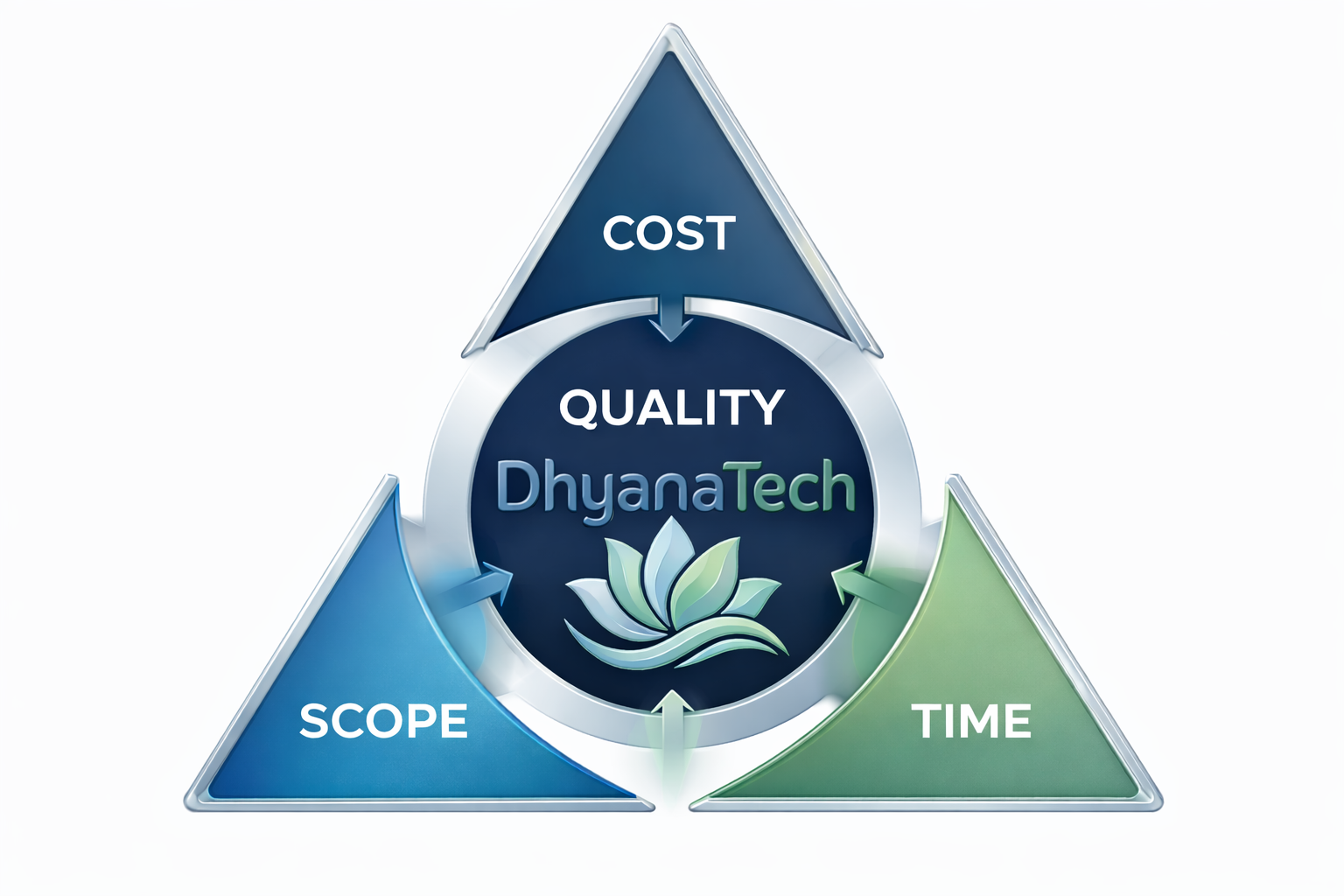 The traditional Iron Triangle model suggests you can only optimize two of three constraints
But here's the thing: it was never a law. It was a model—one designed in 1969 by Dr. Martin Barnes to help teams visualize trade-offs. And somewhere along the way, a useful thinking tool became an excuse for mediocrity.
At DhyanaTech, we built DhyanaPM because we believe the real constraints on your projects aren't scope, time, and cost. They're noise, ambiguity, and wasted effort.
The Real Reasons Projects Fail
The Standish Group has been tracking project outcomes since 1994 through their CHAOS Reports. Their findings might surprise you.
In the original study, only 16.2% of software projects were delivered on time and on budget. A staggering 31.1% were canceled before completion, and those that did finish ran an average of 189% over their original cost estimates.
But here's the crucial insight: the reasons for failure had almost nothing to do with the Iron Triangle trade-offs. The top factors were unclear requirements, poor communication, and lack of stakeholder engagement.
In other words, projects don't fail because someone made the wrong choice between fast and cheap. They fail because teams are swimming in confusion, spending their energy on coordination overhead instead of actual work.
The Planning Fallacy: We're All Overconfident
Psychologists Daniel Kahneman and Amos Tversky identified something called the "planning fallacy" back in 1979. Put simply: humans are systematically terrible at estimating how long things will take—and we don't learn from our mistakes.
In one study, psychology students were asked to estimate when they'd finish their senior theses. The average estimate was 33.9 days. The average actual completion time? 55.5 days. Only 30% of students finished anywhere close to their prediction.
The kicker? Even after experiencing this gap repeatedly, people continue to believe their current estimate is realistic, while acknowledging their past estimates were off. We're all walking around convinced that this time will be different.
Sound familiar?
Traditional project management responds to this by adding buffers, padding estimates, building in "contingency." But that's treating the symptom, not the cause. What if instead, we built tools that acknowledge drift as a normal part of work—and made it visible in real-time?
A Different Approach: Mindful Project Management
DhyanaPM isn't another enterprise platform with a hundred features you'll never use. It's a personal project management app built on a simple philosophy: reduce noise so you can focus on what matters.
Here's what that means in practice:
Critical Path Analysis
Instead of vague discussions about trade-offs, DhyanaPM identifies exactly which tasks determine your project timeline. No more guessing which delay actually matters.
Actual vs. Baseline Tracking
We don't pretend your original estimate was sacred. DhyanaPM tracks what actually happened against what you planned, so you can see drift as it occurs—not six weeks later in a post-mortem.
Reusable Task Templates
If you've figured out the right sequence for a type of work, why reinvent it every time? Build it once, use it forever. That's what "do it right the first time" actually looks like.
AI-Assisted Workflows
Smart suggestions that help you structure work without taking over. Technology that knows its place.
Works Offline
Because not every job site has WiFi, and your planning shouldn't stop when your connection does.
The Iron Triangle Isn't Wrong. It's Incomplete.
Dr. Barnes created a useful model for thinking about constraints. The problem is when we treat it as destiny instead of a starting point.
Modern research—from agile methodologies to lean startup principles—shows that the supposed constraints of time, cost, and scope aren't fixed. They shift based on how well your team communicates, how clearly requirements are understood, and how much friction exists in your coordination.
Remove the friction, and you change what's possible.
That's what DhyanaPM is designed to do. Not by adding complexity, but by stripping it away. Not by giving you more features, but by giving you clearer vision.
Ready to See the Difference?
DhyanaPM is built for individuals and small teams who want to manage projects without the overhead of enterprise software. It's lightweight, thoughtful, and designed to get out of your way.
No credit card required. No 47-step onboarding. Just clarity.
DhyanaPM is part of the DhyanaTech suite of mindful productivity tools. Learn more at dhyanatech.com.
References
- Standish Group. (1994). The CHAOS Report. The Standish Group International.
- Standish Group. (2020). CHAOS 2020: Beyond Infinity. The Standish Group International.
- Kahneman, D., & Tversky, A. (1979). Intuitive prediction: Biases and corrective procedures. TIMS Studies in Management Science, 12, 313-327.
- Buehler, R., Griffin, D., & Ross, M. (1994). Exploring the "planning fallacy": Why people underestimate their task completion times. Journal of Personality and Social Psychology, 67(3), 366-381.
- Barnes, M. (1969). Time and Money in Contract Control. [Course materials, later developed into cost/time/quality triangle model].